 This month, Stephanie picked diner food, street food, and the like as a Blog Party theme. I must admit, I've always wanted to live in a city where I could get really good street food - Middle Eastern, Jewish, North African, etc - but when I'm in France, I certainly don't care, because French street food is the best thing you could ask for. When I lived in Montpellier, I would literally to two patisseries every morning on the way to school for TWO pastry breakfasts, then have another pastry or perhaps a sandwich at our ten am break, then a crepe on the way to lunch... no wonder I gained weight. My favourite crepe is the Grand Marnier and sugar variety, and I make it whenever I get a chance in my cast-iron skillet at home, always with my trusty Joy of Cooking recipe. I have plenty of authentic French ones, but I just can't break away from good old Erma. So basically, you want to sift together 3/4 cup flour, 1 t baking powder, 1/2 t salt, and 2 T powdered sugar, then make a well, beat together two eggs with 2/3 cup milk, 1/3 cup water, and 1/2 t vanilla, and add to the well. Combine with a "few swift strokes," though I always use more than a few. Lumps are all right but not huge hunks of flour. Cover and let sit an hour at room temperature or several in the fridge, then give it a good stir. Add milk if it's thickened too much but I don't usually have to. Wipe a cast iron skillet with vegetable oil and put over medium heat. Do the water test, and when the water drops jump but don't immediately evaporate, it's ready. Use a measuring cup to pour the batter in a swirl from the centre of the pan outward, simultaneously holding the pan above the burner and swirling the pan itself to let the batter spread outward. It should be extremely thin. It takes a while to get the hang of this, so don't fret. When the top looks dry, loosen with a spatula around the edges and use your fingers to lift and check. When light brown over most of the bottom, flip, using your fingers to help, and cook only about thirty seconds on this side. Put on a plate, sprinkle with sugar, splash with Grand Marnier, fold into quarters, and consume immediately. Add a wee bit of oil to the pan after every two crepes, and lower the heat after three or four, because cast iron gets quite hot. As for the beverage, I hope Stephanie won't kill me for not divulging the recipe - yet. I've entered it into a contest, but in about a month when they announce the winners I'll be sure to post it. Suffice to to say, it's a fabulous dark drinking chocolate, and yes, a little of that Grand Marnier made it in as well.
Showing posts with label French. Show all posts
Showing posts with label French. Show all posts
13 April 2008
Blog Party, French Street Food Style
This month, Stephanie picked diner food, street food, and the like as a Blog Party theme. I must admit, I've always wanted to live in a city where I could get really good street food - Middle Eastern, Jewish, North African, etc - but when I'm in France, I certainly don't care, because French street food is the best thing you could ask for. When I lived in Montpellier, I would literally to two patisseries every morning on the way to school for TWO pastry breakfasts, then have another pastry or perhaps a sandwich at our ten am break, then a crepe on the way to lunch... no wonder I gained weight. My favourite crepe is the Grand Marnier and sugar variety, and I make it whenever I get a chance in my cast-iron skillet at home, always with my trusty Joy of Cooking recipe. I have plenty of authentic French ones, but I just can't break away from good old Erma. So basically, you want to sift together 3/4 cup flour, 1 t baking powder, 1/2 t salt, and 2 T powdered sugar, then make a well, beat together two eggs with 2/3 cup milk, 1/3 cup water, and 1/2 t vanilla, and add to the well. Combine with a "few swift strokes," though I always use more than a few. Lumps are all right but not huge hunks of flour. Cover and let sit an hour at room temperature or several in the fridge, then give it a good stir. Add milk if it's thickened too much but I don't usually have to. Wipe a cast iron skillet with vegetable oil and put over medium heat. Do the water test, and when the water drops jump but don't immediately evaporate, it's ready. Use a measuring cup to pour the batter in a swirl from the centre of the pan outward, simultaneously holding the pan above the burner and swirling the pan itself to let the batter spread outward. It should be extremely thin. It takes a while to get the hang of this, so don't fret. When the top looks dry, loosen with a spatula around the edges and use your fingers to lift and check. When light brown over most of the bottom, flip, using your fingers to help, and cook only about thirty seconds on this side. Put on a plate, sprinkle with sugar, splash with Grand Marnier, fold into quarters, and consume immediately. Add a wee bit of oil to the pan after every two crepes, and lower the heat after three or four, because cast iron gets quite hot. As for the beverage, I hope Stephanie won't kill me for not divulging the recipe - yet. I've entered it into a contest, but in about a month when they announce the winners I'll be sure to post it. Suffice to to say, it's a fabulous dark drinking chocolate, and yes, a little of that Grand Marnier made it in as well.


16 September 2007
Death By Chocolate
So it's eleven pm here in eastern Iowa, and after a three hour Quire practice (the local LGBT choral group I just joined) I finally finished the trial brief draft that's due tomorrow morning. I have to be up at 5:30 for work, but there's still an hour left to write a post for this week's Weekend Cookbook Challenge, and I just can't resist the opportunity to tell you the storied history of my most famous (in my family, at least) cookbook.
 I'm not sure I can say Mourir de Chocolat is my favourite cookbook, as it's just too impractical and involves too much effort to be an everday favourite. But this hulking hardback has travelled all over the world with me, including back and forth across the Atlantic twice, and it is certainly the cookbook that in my cookbook that is really mine, that has transcended whatever the author intended for it and become legendary within my family. In other words, I have made this book my bitch.
 When I was sixteen, I went on exchange trip to Ulm, Germany. Halfway through, my mother flew to Frankfurt-am-main, took the train to Ulm, and "picked me up" for a three-day jaunt to Paris. The first night in town, we went to a restaurant I found in one of those Paris on $50 a day guides, that to this day is probably the restaurant I remember most from any trip to Europe. There was just something about my very first meal in France, my first experience with a chalkboard "menu," my first foie gras... I don't even know that le Restaurant Perraudin was in reality all that fabulous, but I've never forgotten its name.
 The part of that dining experience I tend to gloss over is something probably familiar to most Americans who've travelled in Europe. When we arrived, on a rainy evening maybe fifteen minutes before our seven o clock reservation, the restaurant wasn't even open yet. So we walked across the street to a bookshop I'd noticed. It was nothing special, just a little shop with books stacked up to the ceiling, but on a shelf to the left as you walk in, I found a plethora of cookbooks, including Mourir de Chocolat. Looking at the pictures, you can hardly blame me for falling in love. I love chocolate, and I loved the idea of cooking French recipes, from the French, back at home. This was before the days of foodblogging and Clotilde and Loukoum and my other favourite French foodbloggers, so you have to understand that this experience was something of an epiphany.
 The first recipe I made was for the fourth of July when we returned. We were having an indoor picnic at my father's house, and I wanted to provide the dessert. It is this cake that my parents think of when I mention "the book," and it's the one I always talk about when I tell someone that I like to bake. I think it took about five hours to assemble, and the recipe included many pounds of butter, sugar, and chocolate, as well as three different preperations that had to be put together. It was the densest cake I've ever eaten, and though not overwhelmingly sweet, it was very, very chocolatey. It didn't look quite like the pictures (the strawberries kind of collapsed and became muddy in colour under the pressure of the cake itself) but I'll never forget the look on my father's face after I took the first bite. I literally thought I'd killed him.
 My next attempt came a year later, another fourth of July. This time it was the pear tart, with pears marianated in rose wine and a chocolate cream base. I wish I had thought to take pictures, because my rose pattern really was remarkably close to the one in the picture. It was also very tasty, and I keep meaning to do it again, but just haven't got around to it.
 When I decided to do another recipe from the book for this challenge, I knew I couldn't quite manage the cake again. I am, after all, in law school, and extremely busy, not to mention on a budget. The book, however, is divided into the chapters based on levels of chocolate intensity and difficulty of preperation, so while I wasn't quite ready to attack "delire" (in fact, none of the recipes I've tried have been from that hallowed section), I felt ready for the black and white truffles in chapter two. I made a mess of my kitchen, but they were surprisingly easy, and so now I bring you my recipe for WCC #20:
Black and White Truffles

 If you can read French, you'll see that I didn't quite follow the rules for this recipe. I don't actually have aluminum bowls, so I used the plain old ceramic ones I eat my cereal from. I really don't think it affected anything. Also, the sidebar suggested a number of possibilities for rolling the truffles, and though I tried several I found that you really can't go wrong with good old cocoa powder. When I tried a cayenne one I nearly burned my tongue out.
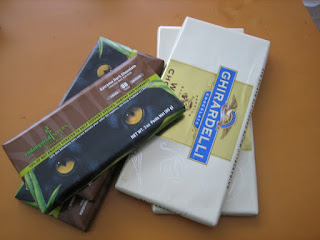 Any truffle starts with the all-important selection of chocolate. You want something high quality, because there aren't a bunch of other ingredients to alter the taste - you've pretty much got your chocolate, your cream, and whatever you roll or dip the truffles in. I was intrigued by these Endangered Species chocolate bars. The extreme dark I used here has a respectable cocoa content, but it's a bit sweeter than the semisweet the recipe recommends. And of course, you can't go wrong with Ghiradelli. The white chocolate is very sweet, but it melts perfectly.
 The first part of the recipe, the preparation of two chocolate ganaches, is the easiest. Break your chocolate, 220 g white and 225 g dark, into one-centimetre pieces. I used my hands, and I found the Ghiradelli very easy to break. The dark chocolate was a little harder, and I think the larger pieces did affect my results later on, so I suppose the smaller the better.
 Next, heat 3/4 cup cream over medium heat. This is always a bit tricky with French recipes, because French dairy products and American ones don't exactly match up. I went with plain old heavy whipping cream, and I think it was a smart move, but you might experiment with different milkfats to see what works for you. Bring it to the boil, but keep in mind that cream isn't going to come to a big fat rolling boil like water, and you don't want it to burn. Pour half over the white chocolate, and half over the dark, and let the bowls sit for five minutes.
 Now you want to stir each bowl with a separate fork, and I have to admit here that I had a bit of a disaster with my dark chocolate. At first I was afraid there might be too much cream, but when I started to stir the ganache was lumpy and some large bits of the chocolate just weren't melting enough to stir in. I went with the remedy the book reccomends, namely a hot water bath. Well I was a bit stupid and overfilled my water bowl, so some of the water sloshed into the ganache! Fortunately, I was able to drain most of it and finish stirring, but I didn't try again, so there are a few hard chocolate bits in my truffles. Oh, well.
 The white chocolate, on the other hand, turned out very smooth, and honestly I wouldn't have minded it a little thicker, but the balance ended up all right. After that ordeal, I let both bowls sit for an hour, and then popped them in the fridge for 15 minutes, stirring every five.
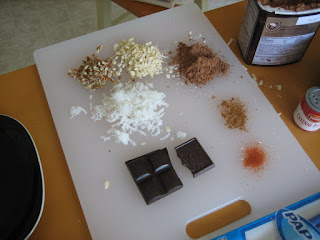 You can roll your truffles in anything you want, but I put all the options on my cutting board, and I tried chopped pecans, chopped almonds, coconut, cocoa powder, cinnamon, cayenne pepper, and grated chocolate. The cocoa works the best, though the coconut wasn't bad and the nuts would've been better if they were more finely chopped. Next time, I want to try dipping them in chocolate, or hiding something in the centre of each truffle.
 For assembly, put the dark chocolate on a sheet of wax paper by the teaspoonful and top each with a teaspoon of white chocolate. Then roll each into a ball with your hands. I took the author's recommendation and coated my hands with cocoa powder, drying them anytime they got too moist, and this helped a lot. Roll your truffles in whatever you want, and eat them immediately or refrigerate. Bon appetit!
 Note: For those of you keeping score, it is now 11:48 pm, which gives me twelve minutes to hit the post button and e-mail my entry. I'd like to point out that I ate neither lunch nor dinner today, but I somehow managed to find time to make truffles. Oh, the life of an amateur chef.
 I'm not sure I can say Mourir de Chocolat is my favourite cookbook, as it's just too impractical and involves too much effort to be an everday favourite. But this hulking hardback has travelled all over the world with me, including back and forth across the Atlantic twice, and it is certainly the cookbook that in my cookbook that is really mine, that has transcended whatever the author intended for it and become legendary within my family. In other words, I have made this book my bitch.
 When I was sixteen, I went on exchange trip to Ulm, Germany. Halfway through, my mother flew to Frankfurt-am-main, took the train to Ulm, and "picked me up" for a three-day jaunt to Paris. The first night in town, we went to a restaurant I found in one of those Paris on $50 a day guides, that to this day is probably the restaurant I remember most from any trip to Europe. There was just something about my very first meal in France, my first experience with a chalkboard "menu," my first foie gras... I don't even know that le Restaurant Perraudin was in reality all that fabulous, but I've never forgotten its name.
 The part of that dining experience I tend to gloss over is something probably familiar to most Americans who've travelled in Europe. When we arrived, on a rainy evening maybe fifteen minutes before our seven o clock reservation, the restaurant wasn't even open yet. So we walked across the street to a bookshop I'd noticed. It was nothing special, just a little shop with books stacked up to the ceiling, but on a shelf to the left as you walk in, I found a plethora of cookbooks, including Mourir de Chocolat. Looking at the pictures, you can hardly blame me for falling in love. I love chocolate, and I loved the idea of cooking French recipes, from the French, back at home. This was before the days of foodblogging and Clotilde and Loukoum and my other favourite French foodbloggers, so you have to understand that this experience was something of an epiphany.
 The first recipe I made was for the fourth of July when we returned. We were having an indoor picnic at my father's house, and I wanted to provide the dessert. It is this cake that my parents think of when I mention "the book," and it's the one I always talk about when I tell someone that I like to bake. I think it took about five hours to assemble, and the recipe included many pounds of butter, sugar, and chocolate, as well as three different preperations that had to be put together. It was the densest cake I've ever eaten, and though not overwhelmingly sweet, it was very, very chocolatey. It didn't look quite like the pictures (the strawberries kind of collapsed and became muddy in colour under the pressure of the cake itself) but I'll never forget the look on my father's face after I took the first bite. I literally thought I'd killed him.
 My next attempt came a year later, another fourth of July. This time it was the pear tart, with pears marianated in rose wine and a chocolate cream base. I wish I had thought to take pictures, because my rose pattern really was remarkably close to the one in the picture. It was also very tasty, and I keep meaning to do it again, but just haven't got around to it.
 When I decided to do another recipe from the book for this challenge, I knew I couldn't quite manage the cake again. I am, after all, in law school, and extremely busy, not to mention on a budget. The book, however, is divided into the chapters based on levels of chocolate intensity and difficulty of preperation, so while I wasn't quite ready to attack "delire" (in fact, none of the recipes I've tried have been from that hallowed section), I felt ready for the black and white truffles in chapter two. I made a mess of my kitchen, but they were surprisingly easy, and so now I bring you my recipe for WCC #20:
Black and White Truffles

 If you can read French, you'll see that I didn't quite follow the rules for this recipe. I don't actually have aluminum bowls, so I used the plain old ceramic ones I eat my cereal from. I really don't think it affected anything. Also, the sidebar suggested a number of possibilities for rolling the truffles, and though I tried several I found that you really can't go wrong with good old cocoa powder. When I tried a cayenne one I nearly burned my tongue out.
 Any truffle starts with the all-important selection of chocolate. You want something high quality, because there aren't a bunch of other ingredients to alter the taste - you've pretty much got your chocolate, your cream, and whatever you roll or dip the truffles in. I was intrigued by these Endangered Species chocolate bars. The extreme dark I used here has a respectable cocoa content, but it's a bit sweeter than the semisweet the recipe recommends. And of course, you can't go wrong with Ghiradelli. The white chocolate is very sweet, but it melts perfectly.
 The first part of the recipe, the preparation of two chocolate ganaches, is the easiest. Break your chocolate, 220 g white and 225 g dark, into one-centimetre pieces. I used my hands, and I found the Ghiradelli very easy to break. The dark chocolate was a little harder, and I think the larger pieces did affect my results later on, so I suppose the smaller the better.
 Next, heat 3/4 cup cream over medium heat. This is always a bit tricky with French recipes, because French dairy products and American ones don't exactly match up. I went with plain old heavy whipping cream, and I think it was a smart move, but you might experiment with different milkfats to see what works for you. Bring it to the boil, but keep in mind that cream isn't going to come to a big fat rolling boil like water, and you don't want it to burn. Pour half over the white chocolate, and half over the dark, and let the bowls sit for five minutes.
 Now you want to stir each bowl with a separate fork, and I have to admit here that I had a bit of a disaster with my dark chocolate. At first I was afraid there might be too much cream, but when I started to stir the ganache was lumpy and some large bits of the chocolate just weren't melting enough to stir in. I went with the remedy the book reccomends, namely a hot water bath. Well I was a bit stupid and overfilled my water bowl, so some of the water sloshed into the ganache! Fortunately, I was able to drain most of it and finish stirring, but I didn't try again, so there are a few hard chocolate bits in my truffles. Oh, well.
 The white chocolate, on the other hand, turned out very smooth, and honestly I wouldn't have minded it a little thicker, but the balance ended up all right. After that ordeal, I let both bowls sit for an hour, and then popped them in the fridge for 15 minutes, stirring every five.
 You can roll your truffles in anything you want, but I put all the options on my cutting board, and I tried chopped pecans, chopped almonds, coconut, cocoa powder, cinnamon, cayenne pepper, and grated chocolate. The cocoa works the best, though the coconut wasn't bad and the nuts would've been better if they were more finely chopped. Next time, I want to try dipping them in chocolate, or hiding something in the centre of each truffle.
 For assembly, put the dark chocolate on a sheet of wax paper by the teaspoonful and top each with a teaspoon of white chocolate. Then roll each into a ball with your hands. I took the author's recommendation and coated my hands with cocoa powder, drying them anytime they got too moist, and this helped a lot. Roll your truffles in whatever you want, and eat them immediately or refrigerate. Bon appetit!
 Note: For those of you keeping score, it is now 11:48 pm, which gives me twelve minutes to hit the post button and e-mail my entry. I'd like to point out that I ate neither lunch nor dinner today, but I somehow managed to find time to make truffles. Oh, the life of an amateur chef.
Subscribe to:
Posts (Atom)